Social Housing Sturhof
Back
Location number: 1020014
Am Wasser
Aussichtsplattform
Gemeindebau
Innenhof
Stiege
Stiegenhaus
Wiese
Wohnhausanlage
1930er
Innen- & Außenbereich
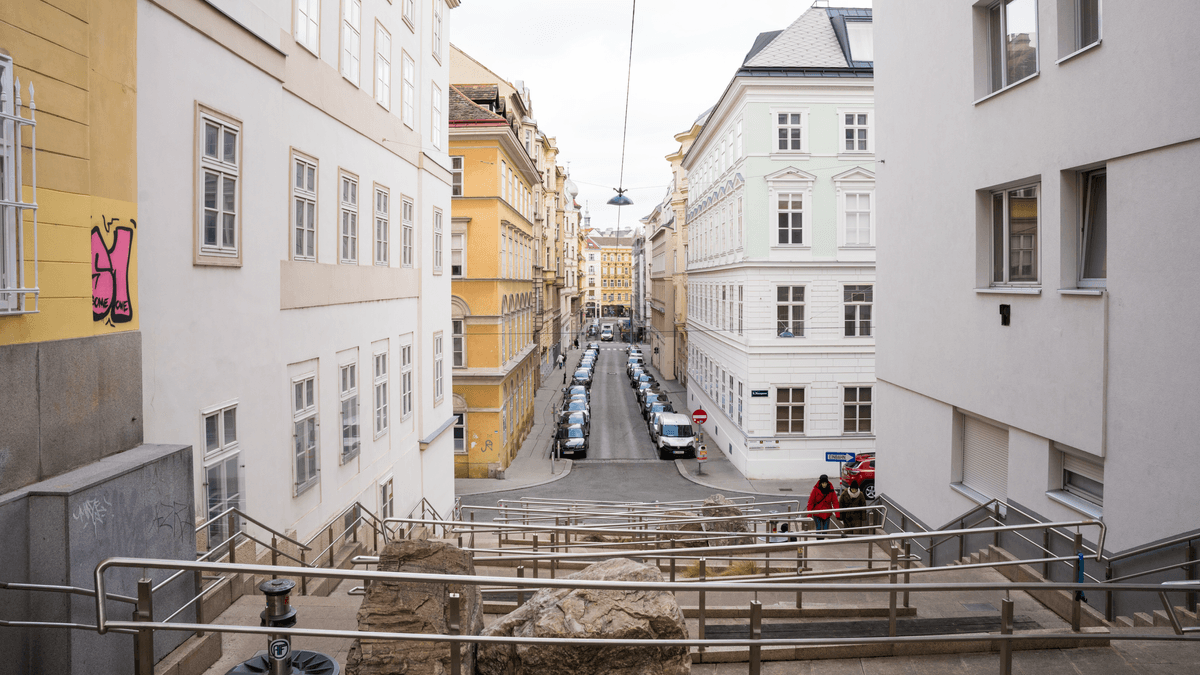
Due to the constant risk of flooding, the area remained uninhabited for centuries. Only the Danube regulation between 1870 and 1875 brought the river under control, laying the foundation for industrialization and the economic development of the Danube Monarchy. The residential quarter was built within a short period with a uniform character; in 1930, the property was transferred from the Danube Regulation Fund to the City of Vienna. The monumental building block consists of four wings arranged at right angles, enclosing a large, landscaped inner courtyard, with stone-framed entrances on Engerthstraße, Sturgasse, and Offenbachstraße. The façade is clearly and effectively structured: balconies emphasize the main entrance, slightly projecting wall sections group the windows into bands and axes, and the alternation of yellow plaster with light gray elements creates a distinctive appearance. Accentuated corners and tower-like courtyard projections with vertically grouped window axes further reinforce the building’s characteristic overall impression. The street is named after Hofrat Wilhelm Ritter von Engerth (1814–1884), General Inspector of the State Railway Company, member of the Danube Regulation Commission, and designer of the barrier ship at the entrance to the Danube Canal in Nussdorf.